Ethics
Management System
Organizational Structure
Audit Committee
POSCO’s ethical management is overseen by the Corporate Audit Office, which reports directly to the CEO. The office carries out a wide range of activities across domestic operations and overseas subsidiaries. These include supporting the development and implementation of ethical management policies, delivering tailored ethics training and awareness programs, conducting audits into unethical conduct, reviewing cases involving violations of human dignity, and managing related grievances.

Policies and Guidelines
Ethical Standards and Policies
POSCO became the first company in Korea to introduce a Code of Conduct in 1993, followed by the launch of its Code of Ethics in 2003, which established ethics as a core management principle. In 2024, a new ethical management framework was introduced, broadening the scope of ethics management beyond individual conduct to include a stronger focus on empathy toward stakeholders such as employees, business partners, and local communities. Through this initiative, we aim to foster an ethical management culture that aligns with global best practices.
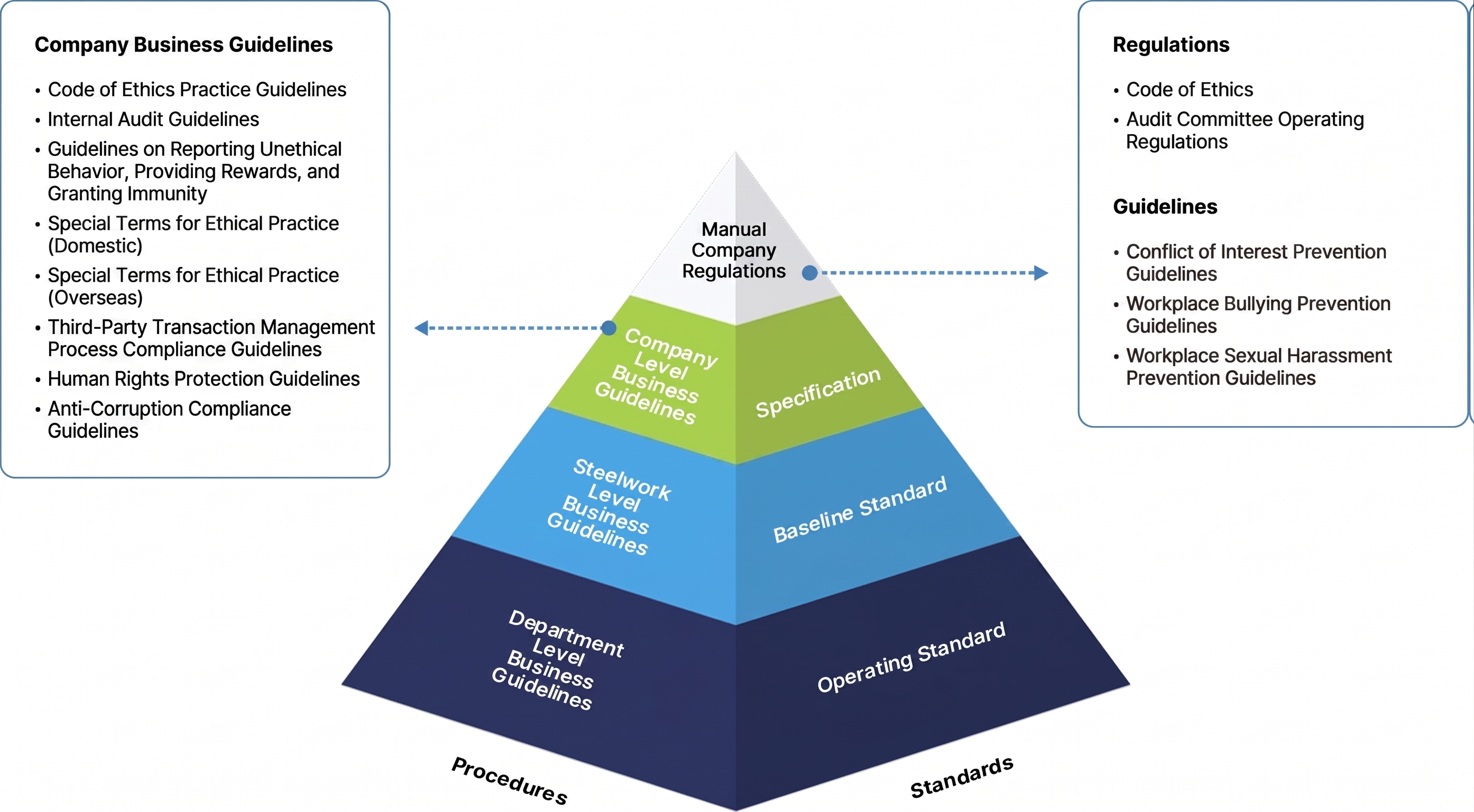
We operate 12 ethical management standards and policies, comprising five regulations and seven operational guidelines. These include the Code of Ethics, the Regulations on the Operation of the Audit Committee, and Internal Audit Guidelines. Our Corporate Audit Office oversees these frameworks and regularly reviews their effectiveness.
Ethical Management Standard Operating Framework
Ethical Management Process
Management Activities
Ethics Training
Conducting Ethics Training
POSCO promotes ethical awareness and practice by collecting annual ethics pledges from all executives and employees at every worksite, while also providing regular training and conducting ethics campaigns. Since 2024, we have introduced an executive ethics pledge and have held annual Ethics Dialogues, in which each executive engages in open discussions with their team on ethical management.
| Content | Target | Frequency |
|---|---|---|
| Ethics Training | All executives and employees (including contingent workers) | Once a year |
| Ethics Pledge | All executives and employees (including contingent workers) | Once a year |
| Executives’ Ethics Pledge | All executives | Once a year |
Ethics Dialogue | All executives | Once a year |
We provide both online and offline training programs for all executives and employees across domestic and international sites. “Understanding POSCO’s Ethical Management,” which is based on real-world counseling and audit cases, and “Preventing Workplace Sexual Harassment and Bullying” are offered as mandatory e-learning courses for all employees. We also run monthly ethical management campaigns that provide practical guidance on responding to ethical dilemmas and preventing workplace harassment, with materials distributed across all POSCO Group companies. Upon request from customer-facing and procurement departments, we deliver tailored, case-based training sessions to help reduce ethical risks in day-to-day operations. English-language campaign materials are also distributed to overseas subsidiaries to support training for global staff.
Ethics Training
| Online |
· Mandatory e-learning courses: "Understanding POSCO's Ethical Management" and "Preventing Workplace Sexual Harassment and Bullying" · Company-wide posting of ethics campaign materials covering unethical behavior, bullying, sexual harassment, and abuse of power · Distribution of campaign resources through the Global Information Hub (GIH) system |
| Offline |
· Training by corporate hierarchy and grade: Separate programs for distinct employee groups (new executives, position holders, and expatriates; new, experienced, and intern hires; and overseas local hires) · Department-specific training: Case-based, in-depth sessions for departments engaging with external stakeholders, including the Raw Materials Office, Investment Planning and Engineering Office, and Marketing Division · Special training on sexual ethics: Targeted training on sexual ethics compliance for less-tenured employees(6,142 participants), with external experts serving as lecturers * A cumulative total of 14,523 employees have completed the training over three years, including long-tenured employees in 2023 (3,308 participants) and mid-level employees in 2024 (5,073 participants) ** Executives and position holders are required to complete PIUM training every year. |
Ethics Risk Management Activities
Risk&Opportunity Assessment Method and Results
POSCO maintains 12 ethical management standards and policies that all executives and employees, including contingent workers, are required to comply with. These consist of five company regulations and seven work guidelines, including the Code of Ethics. The Corporate Audit Office oversees the implementation of these regulations and guidelines, while also continuously reviewing their adequacy.
· Company regulations (5): (1) Code of Ethics, (2) Conflict of Interest Prevention Guidelines, (3) Audit Committee Operating Regulations,
(4) Workplace Bullying Prevention Guidelines, (5) Workplace Sexual Harassment Prevention Guidelines.
· Work guidelines (7): (1) Code of Ethics Practice Guidelines, (2) Special Terms for Ethical Practice(Domestic),
(3) Special Terms for Ethical Practice(Overseas), (4) Internal Audit Guidelines,
(5) Anti-Corruption Compliance Guidelines,
(6) Guidelines on Reporting Unethical Behavior, Providing Rewards, and Granting Immunity,
(7) Guidelines on Compliance with Third-Party Transaction Management Processes.
Under the Code of Ethics, “money and goods” refer to any form of economic benefit, including cash and goods. POSCO strictly prohibits executives and employees from offering, requesting, or accepting any unjustified money or goods from stakeholders under any circumstances.
The Anti-Corruption Compliance Guidelines define “corruption” as any act of misconduct involving the acquisition―or enabling a third party to acquire―tangible or intangible benefits, including assets, positions, or opportunities, through illegal or improper means in connection with business activities. Where domestic or international anti-corruption laws, local regulations, the Code of Ethics, or other company regulations conflict, the strictest standard shall prevail.
Diagnostics and Measures
POSCO regularly conducts ethics sessions and employee surveys to assess employees' ethical practices and proactively identify potential unethical risks.
| Executive Ethics Session | Assessment of ethical management mindset among executives (once a year) |
| Position Holders’ Ethics Session | Enhancement of ethical leadership among position holders (once a year) |
| Ethical Risk Detection Survey | Monitoring of work-related unethical conduct and human dignity violations, including sexual harassment and workplace bullying (monthly) |
Operation of the Reporting Center
POSCO operates a Reporting Center, available at all times, where executives and employees can report unethical conduct and violations of respect for human dignity. All reports are handled exclusively by the Corporate Audit Office, which oversees the full process from intake to follow-up. As a matter of principle, all reports submitted through the Reporting Center are subject to a 100% investigation.
In 2023, we expanded the languages supported for report submission beyond Korean and English to include Chinese, Spanish, Vietnamese, and Turkish, enabling foreign nationals at our global worksites to submit reports in their native languages.
Any stakeholder may seek consultation or submit a report. We strictly prohibit any conduct that could result in the disclosure of the identity of those who do so. In addition, executives and employees of the Internal Audit Department are required to sign the Auditor Security Pledge at the start of each year to ensure thorough protection of user identity.
Procedures governing report handling―including confidentiality obligations and investigation processes―are explicitly set out in the Guidelines on Reporting Unethical Behavior, Providing Rewards, and Granting Immunity, incorporating provisions from Chapter 3 of the Public Interest Whistleblower Protection Act that are applicable to private enterprises.
We also require executives and employees to record any solicitations received through the Clean POSCO System, fostering a culture of transparency. In 2025, a total of 410 reports of unethical conduct were received and processed through the Reporting Center.
Report Handling Procedure

Measures for Unethical Conduct
POSCO applies a zero-tolerance policy to four major types of unethical conduct: bribery, embezzlement, sexual ethics violations, and information manipulation. Violations of our ethics code are met with appropriate punishment. We strictly prohibit any action that could reveal the identity of whistleblowers and have formalized a clear framework for enforcing penalties in the event of violations. Executives and employees of the Corporate Audit Office, our dedicated audit organization, submit the Auditor Security Pledge at the start of each year to safeguard whistleblower identities.
Change Management
POSCO receives reports on an ongoing basis through its unethical conduct reporting channel via the Corporate Audit Office's official email account, open to individuals regardless of which company they belong to. Based on these reports, we manage unethical conduct risks across our operations, including those involving business partners.
Ethical Management Performance
Ethics Training
| Indicator | 2023 |
2024 |
2025 |
2026 Target |
|---|---|---|---|---|
| Ethics-training completion rate | 100 |
100 |
100 |
100 |